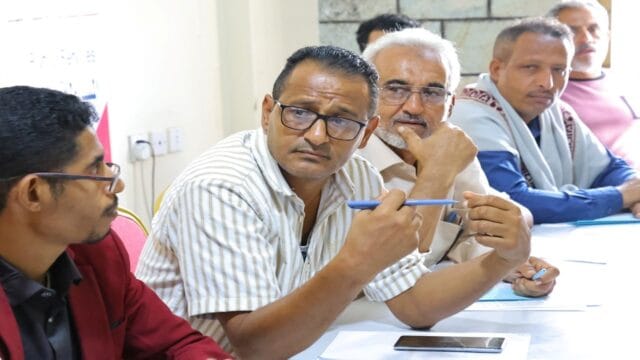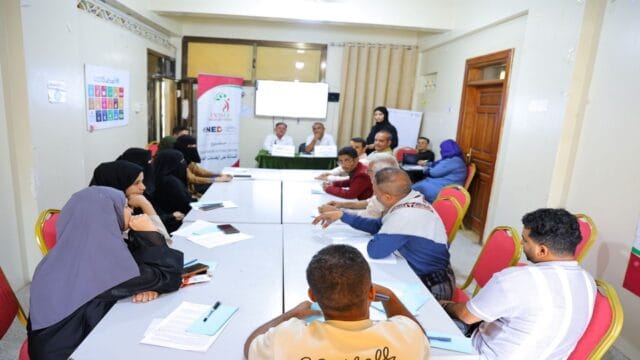
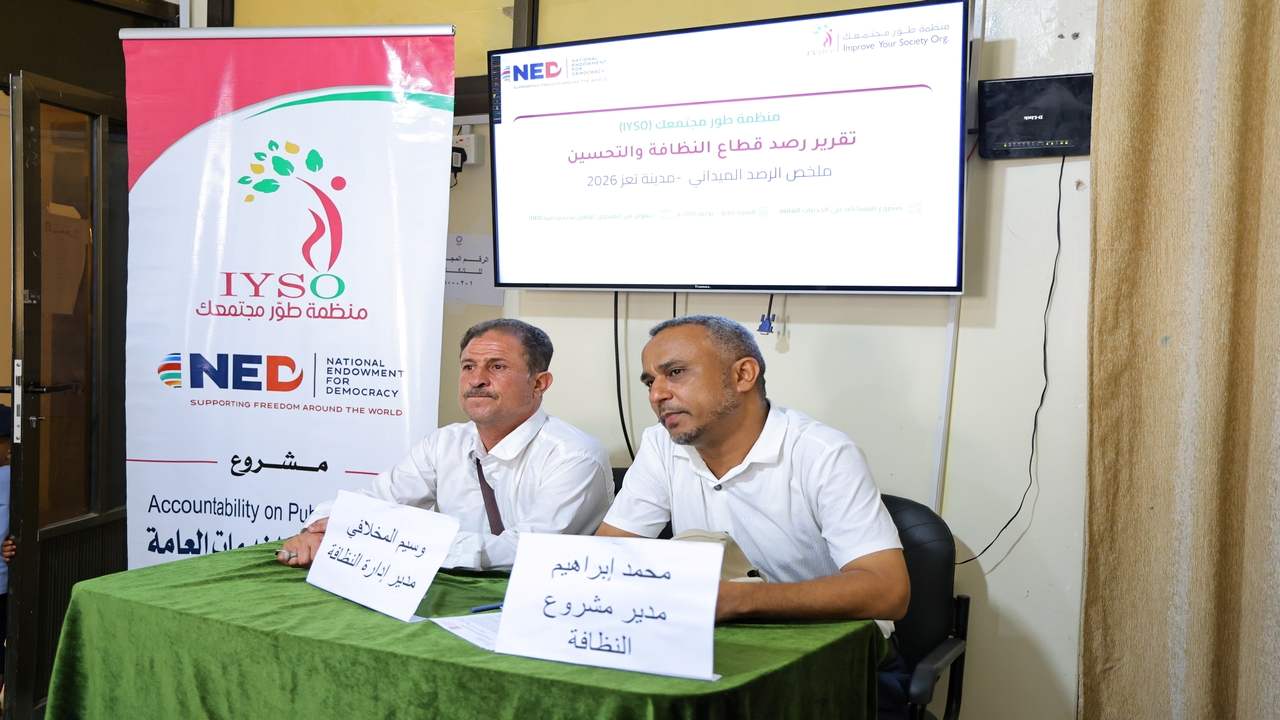
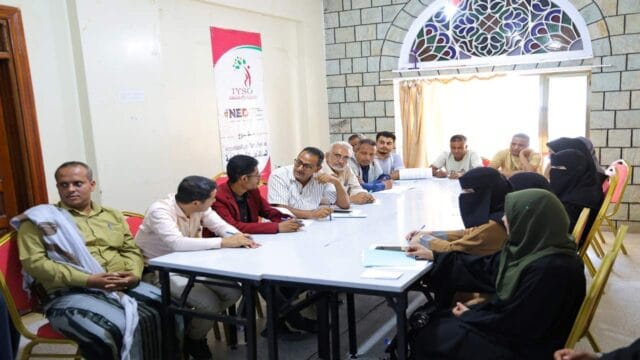
As part of the “Accountability for Public Services” project, Improve Your Society Organization organized a community hearing session on July 29, 2026, in Taiz to discuss the reality of cleanliness services and waste management in the districts of Al-Salah, Al-Mudhaffar, and Al-Qahira. The session was attended by Mohammed Ibrahim Mahyoub, Project Director of Cleanliness, and Waseem Mohammed Ali, Director of the Cleanliness Department, along with 30 participants representing youth, political and community leaders, civil society activists, media professionals, and local organizations, in addition to the Director of the Cleanliness and Improvement Fund in the three districts.
The youth monitoring team presented the findings of a field monitoring report conducted between April and July 2026, which revealed major challenges in the cleanliness sector, including the absence of a comprehensive and sustainable waste management system, weak operational capacities of the Fund due to shortages of equipment, vehicles, and containers, accumulation of waste in several neighborhoods, rising environmental and health risks, spread of random dumps, and the growing phenomenon of stray dogs posing threats to public health.
Officials from the Fund explained that current capacities are insufficient to meet the city’s needs, as around 600 tons of waste are transported daily compared to an actual requirement of 850 tons. They noted that most containers and barrels are worn out, with arrangements underway to provide new ones. Discussions also addressed waste accumulation around public facilities such as Al-Ta’awun Hospital, as well as the problem of random disposal of construction debris inside waste containers, which causes significant operational damage.
The session concluded with several recommendations, most notably: launching community awareness campaigns on proper waste disposal methods, strengthening coordination between the Fund, local authorities, and relevant agencies, supporting community initiatives, mobilizing funding to provide equipment and vehicles, developing mechanisms for managing market and construction waste, and establishing a joint plan to address random dumps within residential neighborhoods.
The session emphasized that improving cleanliness services is a shared responsibility between government entities and the local community, and that the success of future interventions requires stronger partnerships and coordination among all stakeholders, as well as sufficient resources to enhance the operational capacity of the Cleanliness and Improvement Fund, thereby contributing to better public services and responsiveness to citizens’ needs in Taiz.